Rob Hall
The ClimbRob Hall, the New Zealand leader of Adventure Consultants, was both a celebrated commercial guide and a central, ultimately doomed decision-maker in the 1996 Everest disaster. His reputation had been built on successful guided ascents and a disciplined approach; his death followed a summit-day choice that the book presents as a break with one of his cardinal rules, leaving the reasons contested and the consequences wider than his own expedition.
Identity and the Commercial Climb
Hall was thirty-five in 1996, though his black beard, imposing build, and “Lincolnesque” appearance led people to imagine him older. His quiet reserve accompanied an intense manner. Since Adventure Consultants began taking expeditions to Everest in 1990, he had guided a combined thirty-nine clients and expedition personnel to the summit, a record that made him an established name in the growing business of commercial climbing.
That business had its own public theater and private arithmetic. Adventure Consultants camped near the IMAX/IWERKS expedition and Henry Todd’s Himalayan Guides team, among several outfits bringing paying clients to the mountain. Hall’s advertisements in international climbing magazines were large and confident; one, published in early 1995, declared “100% Success! Send for Our Free Color Brochure.” The claim held only until May of that year, when deep snow slowed his team and Hall turned all his clients back without a summit. The reversal mattered commercially: the book notes that success brought new business, while a turnaround did not.
Everest’s commercial promise rested on labor distributed very unevenly. Sherpas left their homes for Base Camp to establish camps, carry loads, cook, and serve climbers, for daily pay ranging from $2.50 to $50. In a later account of the mountain’s route politics, Hall and other expedition leaders appear among those negotiating who would fix the Icefall and who would receive payment for the work. The account criticizes a system in which teams used a route that Sherpas had fixed while organizers controlled the substantial fees, and anticipates a future in which Nepali climbing Sherpas might contract to prepare the route and control more of its earnings. This economic setting frames Hall’s enterprise without erasing the skill and hazardous work on which commercial expeditions depended.
Return to Everest and Rivalry
Hall returned in 1996 determined to regain the winning position after the previous season’s clients had failed to summit. A new competitor sharpened the pressure. Scott Fischer had spent years developing Mountain Madness without securing a steady income from the business; he saw a successful Everest season, with clients paying the same $65,000 asking price Hall charged, as a chance to change its prospects. The rivalry was not simply a matter of personal ambition: in the book’s account, summit success translated directly into future customers and financial stability.
The commercial contest also surfaced in negotiations over Jon Krakauer’s place on the mountain. After Outside sought a lower-cost arrangement through Mountain Madness, it went to Hall and asked what he would offer; Hall quoted less, and Outside bought Krakauer’s ticket from Adventure Consultants at the eleventh hour. The episode is presented as ordinary expedition commerce, in which every party sought the best price and the invoice settled the dispute. Yet it places Hall’s operation inside the same market that made summit records, reputation, and client slots consequential.
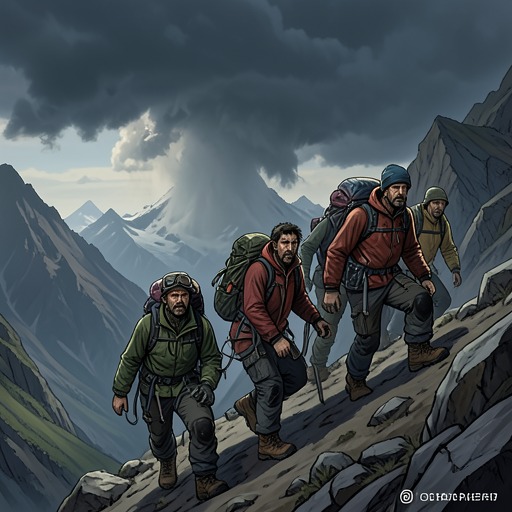
On the mountain, Hall led a large team toward the summit. Fifteen people from his expedition set out, including Hall, two other guides, eight clients, and four Sherpas. His climbers left Camp IV thirty minutes before the Mountain Madness climbers, their headlamps forming a moving chain ahead of the other group. The scale and sequencing of the ascent made Hall’s expedition a visible presence on the route, not a separate undertaking from the other teams’ progress and decisions.
Leadership, Rules, and Summit-Day Choices
Hall’s leadership combined coordination with tightly managed movement. During the first half of summit day, he instructed his climbers to remain within one hundred meters of one another until they reached the Balcony, a cleft below the Southeast Ridge at about 8,500 meters. Jon Krakauer, climbing as a journalist and client, found the constraint frustrating because he was accustomed to making independent decisions. The rule illustrates the tension between a guide’s responsibility to manage a group and the loss of individual discretion imposed by that management.
The timing rule was less clear. Hall had not fixed a single, unequivocal turnaround hour: some climbers understood that they were to turn around at one o’clock, others at two, and still others thought the decision might be made on the mountain. The ambiguity would become important as the climb ran late, because a turnaround deadline can protect a team only when its meaning is shared and its authority is exercised in time.
Hall’s earlier response to bad weather had shown a more explicit willingness to wait or descend. During a severe squall, a climber asked whether conditions were suitable for a summit attempt. Hall replied that the mountain could become calm after a squall; if the weather cleared overnight, his group would try the next day, if not it would wait another twenty-four hours, and if conditions remained bad on the second day, it would descend. The exchange makes his later summit-day decisions harder to reduce to a simple portrait of recklessness: the evidence presents a leader capable of setting conditional limits, alongside the unresolved failure to enforce a limit when it mattered most.
As climbers descended and ascended past one another, Hall was encountered below the summit by a returning climber who initially mistook him for Scott Fischer. Hall said that everyone was doing all right, that no one needed help, and thanked the climber for the fixed ropes. Another account places Hall ahead of Fischer by roughly fifteen or twenty minutes. Hall said he was not in serious difficulty and declined an offer of help. These encounters record the outward appearance of a functioning ascent, even as the team’s schedule and the climbers’ condition were becoming increasingly precarious.
The central decision concerned Doug Hansen. Hall continued upward with Hansen, whose summit arrival was reported after four o’clock. The book calls the choice a breach of one of Hall’s well-known cardinal rules: rather than turn Hansen around, the experienced guide encouraged him to continue. Why he did so remains a question, not an established motive. One proposed explanation was that Hall was competing with Fischer and waiting to see which leader would turn back first; the account notes, however, that by shortly after three Hall knew Fischer’s clients had summited and Fischer was close enough to do so himself. Whatever Hall’s reason, the decision drew the attention of Lopsang Jangbu Sherpa and Hall guide Andy Harris toward Hansen and away from other problems developing on the mountain.
The Collapse and Hall’s Last Contact
By late afternoon the summit push had become a crisis. At about 4:30 p.m., members of Hall’s camp came to Mountain Madness Base Camp seeking oxygen to be sent back up. They reported that a member of their team had collapsed at the Hillary Step and that Hall was with him. Hall’s radio messages likewise said that he was with the collapsed climber. The incident transformed the earlier question of timing into an immediate rescue problem, with Hall remaining high on the route beside Hansen rather than returning with his group.
Two Sherpas from Hall’s expedition went up in an attempt to rescue him and any other team members they might find alive. The weather threatened them, and they turned back without finding anyone. At 6:20 p.m., Hall radioed Base Camp and was patched through to his wife in New Zealand. He sent his love and asked her not to worry. Those were the last words heard from him.
By the morning of May 12, hope for Hall, Hansen, and Andy Harris had been abandoned, and the remaining Adventure Consultants climbers began descending toward the safety of Base Camp. Other climbers who had survived but required evacuation, including Beck Weathers and Makalu Gau, were taken to Camp I, where a helicopter could land and carry them to Kathmandu. The account does not resolve what happened to Hansen after he and Hall were together above the Hillary Step: Hall was later at the South Summit, transmitting messages to Base Camp, but Hansen was no longer with him and had vanished somewhere between those points.
Unanswered Questions and Narrative Significance
The circumstances of Hall’s death remain inseparable from the question of why he stayed so high with Hansen. Surviving members of Adventure Consultants shed little light on the deaths of Hall, his guide Andy Harris, and clients Hansen and Yasuko Namba. The account distinguishes what is known from what is conjectured: Hall was with Hansen above the Hillary Step, later bivouacked at the South Summit, and transmitted to Base Camp; the route and circumstances by which Hansen disappeared remain uncertain. The gap in the record is not filled by a definitive explanation.
Hall’s decision has consequences beyond the two climbers’ immediate predicament. By encouraging Hansen to continue, he altered the priorities of Lopsang Jangbu Sherpa and Harris, drawing them toward Hall and Hansen while other dangers unfolded. That connection makes the choice consequential even where motive cannot be established. It also sharpens the contrast between Hall’s reputation for following rules and the failure to turn Hansen around, a contradiction the book leaves open for readers to weigh rather than resolving into a single judgment.
Hall therefore occupies two roles in the account of Everest: the successful guide whose business depended on confidence, organization, and summit outcomes, and the leader whose late ascent with Hansen became one of the disaster’s most enduring puzzles. The commercial system helps explain why success carried pressure, but does not prove that competition caused his choice. His last radio contact offers a small, concrete human ending amid the unanswered questions: a message of love to his wife, followed by silence.